
Is Your Irish Pension Too Dependent on Seven American Companies?
If you have a pension in Ireland, there is a very good chance that a meaningful slice of your retirement savings is riding on the share prices of just seven US technology companies:
Apple, Microsoft, Nvidia, Alphabet, Amazon, Meta and Tesla - the so-called "Magnificent Seven".
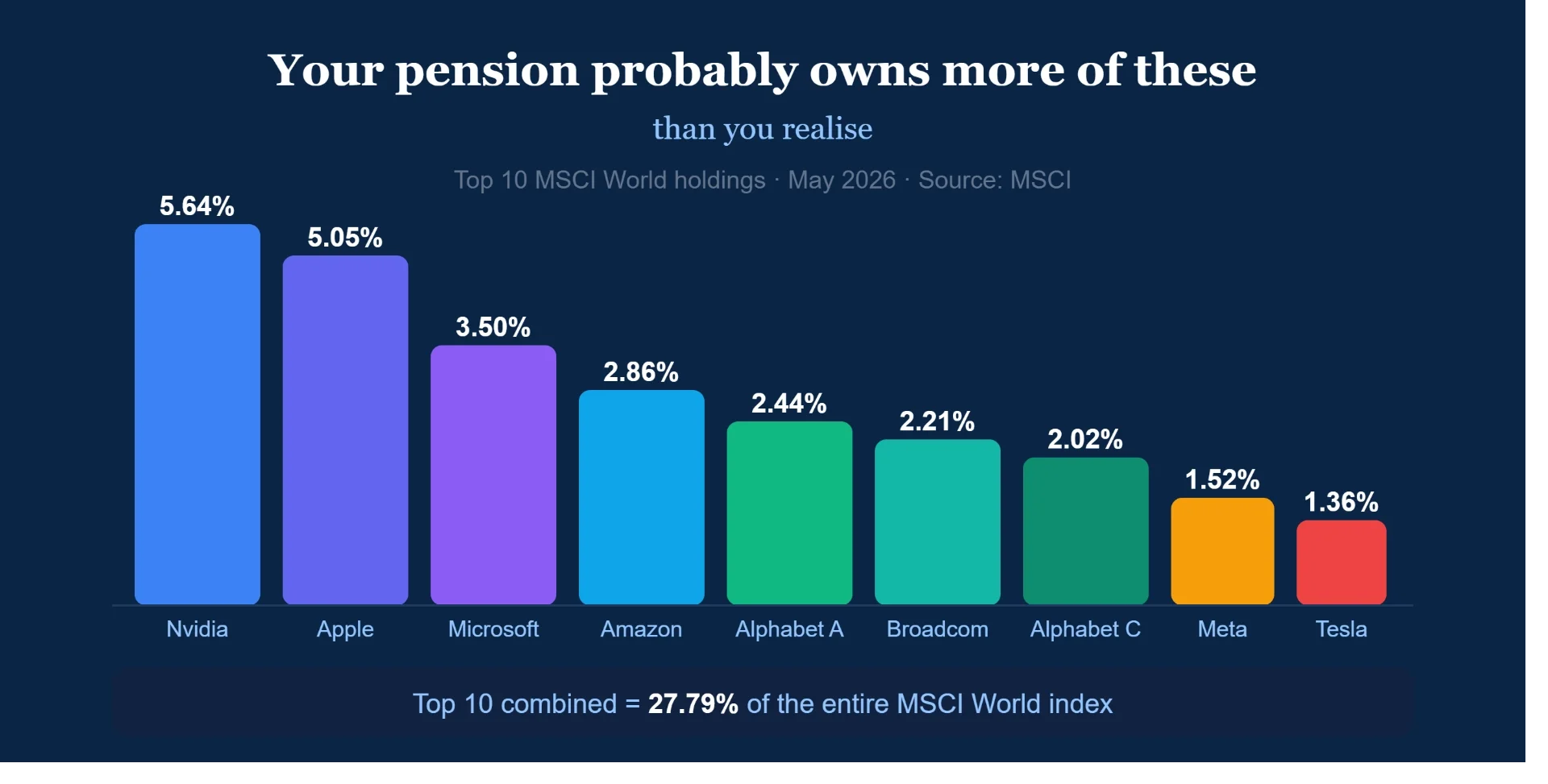
That might sound like an exaggeration. It isn't. Most Irish pension funds, particularly the default and lifestyle strategies offered by the big providers, are heavily invested in global equity indices. Those indices are dominated by the US market, and the US market is in turn dominated by a handful of mega-cap technology stocks. The ten largest companies in the MSCI World index now make up roughly 28% of the entire index - well above the historical norm of 10 to 15%. If your pension tracks a global or North American equity fund, you own more of these seven companies than you probably realise, and your retirement outcome is more tied to their fortunes than any sensible diversification framework would suggest.
This is the kind of blind spot I see regularly. It is nobody's fault - the fund name on your statement says "diversified global equity", and you would reasonably assume that means what it sounds like. Part of my job is to look behind the label on your behalf and point out the risks that are easy to miss.
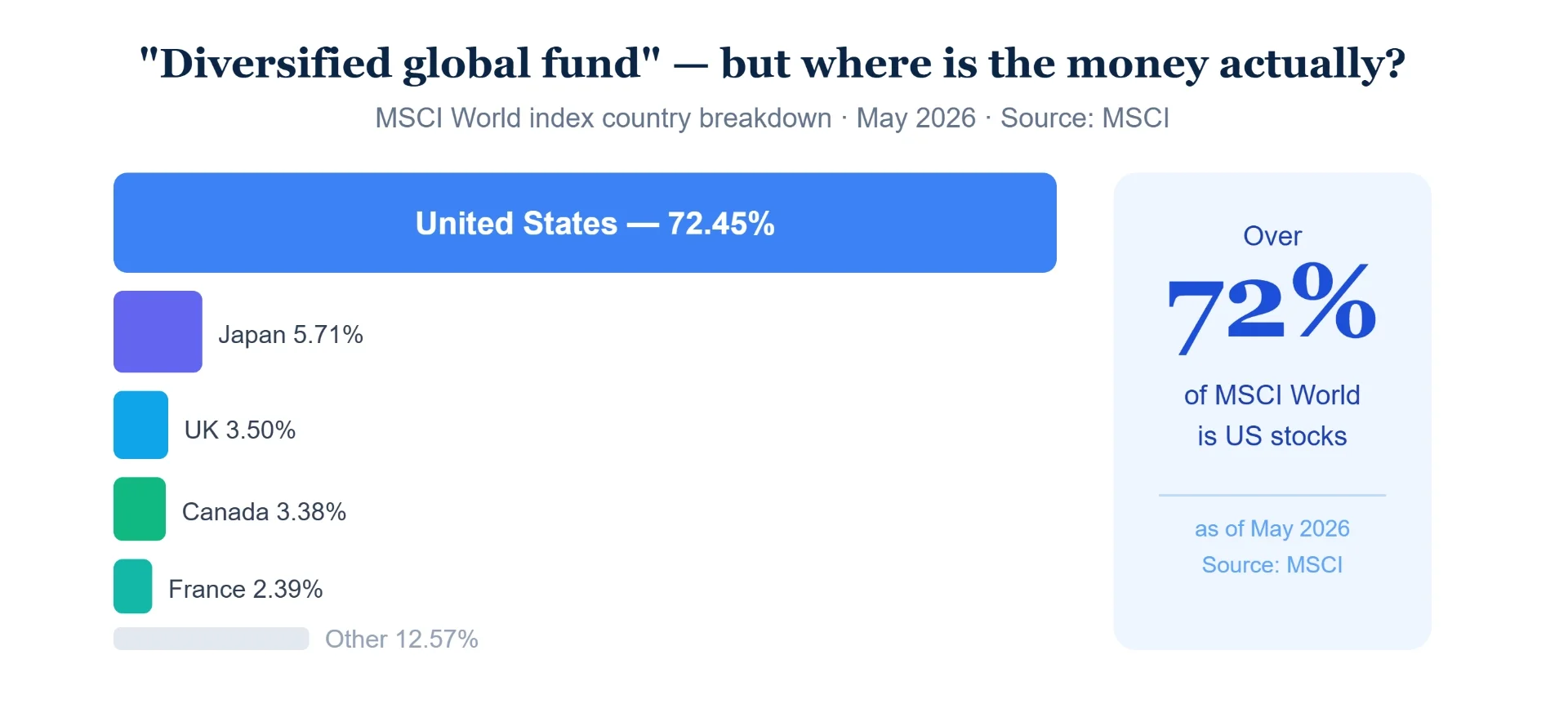
Why I'm paying close attention right now
To be clear: this is not a prediction that US markets are about to crash. Nobody can tell you that, and you should be sceptical of anyone who claims they can. The US economy has been remarkably resilient, corporate earnings have been strong, and the AI investment boom is real.
But when I look at the current environment, a few things stand out.
First, valuations are stretched by almost any historical measure. The gap between what US equities yield and what you can earn on a US government bond - the compensation investors receive for taking equity risk - is close to the lowest on record. In plain English, investors are being paid almost nothing extra for taking on the volatility of shares.
Second, expectations are very high. Analysts are forecasting earnings growth of 14 to 16% for US companies in 2026. When expectations are that elevated, even modest disappointments can trigger outsized market reactions. There is very little margin for error priced in.
Third, the risks are stacking up. Inflation in the US remains sticky. American consumers are showing signs of strain. Energy prices have risen on the back of conflict in the Middle East. There is a new Federal Reserve chair, a midterm election year, and an unpredictable policy environment. None of these guarantees a downturn - but together they describe a market that is priced for perfection at a time when perfection looks harder to deliver.
And there is an Irish dimension too. Our economy is unusually dependent on US multinationals for employment and tax revenue. A serious US downturn wouldn't just show up in your pension statement - it could affect the wider Irish economy at the same time. That is a concentration of risk worth thinking about.
What I've been doing about it
For a number of my clients who are within sight of retirement, I have already begun de-risking, gradually reducing exposure to US equities and to the most concentrated parts of the market, and moving towards a more defensive mix of assets.
I want to be honest about the trade-off involved, because it matters. If US markets continue to climb over the next twelve months, a de-risked portfolio will not capture all of that growth. Clients who follow this approach may well find their fund underperforms the headline indices this year. I am entirely comfortable with that, and I tell clients so directly.

Here is why. If you are five or ten years from retirement, the question is not "how do I squeeze out the last few percent of a bull market?" The question is "can I afford a 30% fall in my fund with no time to recover?" Missing some upside is a cost you can live with. A major drawdown on the eve of retirement is one you may not be able to. Giving up the chance of top-quartile performance this year in exchange for genuine protection is, for the right client, a very good trade.
For younger clients with decades to retirement, the calculation is different - time is on your side, and volatility is something you can ride out and even benefit from. But even then, it is worth understanding just how concentrated your fund actually is, because "diversified global equity fund" on a statement does not always mean what it sounds like.
What you can do now
If any of this resonates with you, the first step is simple: find out what you actually own. Most people have never looked beyond the name of their pension fund. A proper review will tell you what proportion of your fund is in US equities, how exposed you are to the largest technology names, whether your currency risk is hedged, and whether your current risk level still matches your time horizon and your circumstances.
From there, if changes make sense, they can usually be made within your existing pension at little or no cost. De-risking does not mean panicking out of markets - it means deliberately repositioning, in stages, while conditions are calm. The whole point is to act before a problem arrives, not after.
If you are concerned about your pension's exposure to US markets, or you simply want to understand where you stand over the next twelve months, get in touch. I am happy to review your existing fund - whether or not you are a current client - and give you an honest assessment of whether your positioning still makes sense for where you are in life.
You can reach me through the contact page at frontrowadvisory.ie or by email, and we can arrange a no-obligation conversation.